Key Takeaways — brief reading, less than 30 seconds
- Most SaaS companies gate features behind pricing tiers to maximise revenue per customer. YetOnePro includes every feature in every plan — including the free one.
- The real costs in a DAM platform are storage and per-user infrastructure load — not SSO, portals, or AI tagging. Price what actually costs money.
- SSO, custom roles, audit trails, and advanced analytics are Enterprise-only at most competitors. YetOnePro bundles them into a £5/month block.
- Flat, transparent pricing eliminates the need for a sales team — reducing costs and keeping incentives aligned with building a better product.
- Competing on price is a losing strategy. Competing on value with honest pricing is not the same thing.
Glossary10 terms
- DAM: Digital Asset Management — software for storing, organising, and distributing digital files such as images, videos, and documents.
- MRR: Monthly Recurring Revenue — the predictable revenue a subscription business earns each month.
- NRR: Net Revenue Retention — measures how much revenue you keep and expand from existing customers, including upgrades, downgrades, and churn. Above 100% means existing customers are spending more over time.
- OIDC: OpenID Connect — an authentication protocol built on top of OAuth 2.0 for verifying user identity.
- RBAC: Role-Based Access Control — a system where permissions are assigned to roles rather than individual users.
- SaaS: Software as a Service — software delivered over the internet on a subscription basis.
- SAML: Security Assertion Markup Language — an XML-based standard for exchanging authentication data between an identity provider and a service.
- SMB: Small and Medium-sized Business — companies typically with fewer than 500 employees.
- SSO: Single Sign-On — allows users to log in once and access multiple applications without re-entering credentials.
- TOTP: Time-based One-Time Password — a temporary code generated by an authenticator app for two-factor authentication.
Editor's note: This is a personal piece from our founder about how we approach pricing at YetOnePro. It’s opinionated, sometimes blunt, and entirely based on our own experience building a DAM product. If you want the practical details, visit our pricing page.
I don’t like upsells. They come in different forms. Some are relatively honest: you’re offered something extra that you didn’t originally choose. Others are deliberately engineered to steer you towards the more expensive option. I’ve read the marketing literature, of course — squeezing more money out of customers is presented as a cornerstone of good marketing. But my sympathy rarely stays with those companies.
Upsells are everywhere.
- “Would you like to make it a meal?” = “Upgrade to Pro to unlock custom branding.”
- “Add a McFlurry?” = “Enable SSO for an additional fee.”
We designed the pricing for YetOnePro in autumn 2025, before the company was even registered. Every attempt to draft multiple plans — where SSO got pushed into an Enterprise package, or AI Tagging appeared only outside the base plan — left the worst possible taste. I realised I was doing exactly what had repelled me my entire life.
Take white-labelling. The entire workload amounts to loading an image and letting someone pick their brand colours. Why would you sell such a trivial piece of work at a premium price? I don’t see serious effort behind it, yet it gets bundled with other small conveniences and moved into the higher plan. Not because it costs more. Not because it’s harder to build. Simply to create artificial value and push you towards a more expensive package. Work should be well compensated, but it should not manufacture extra value where very little actual effort is involved.
That’s when we made our decision: features that don’t require substantial effort go into one plan. A second plan would only exist for things that genuinely consume serious resources.
And so we began assembling the first plan — a deeply critical process where every decision was weighed, database footprint was calculated, index storage was measured, and data safety was carefully considered. The first plan kept accumulating more and more features. The second plan barely received anything, and it became obvious that this split was lopsided.
But how do you price a plan where everything is included? At that point, it felt like the process would never end. Let’s step back for a moment and look at the market and the competition.
SaaS Learned the Wrong Lesson#
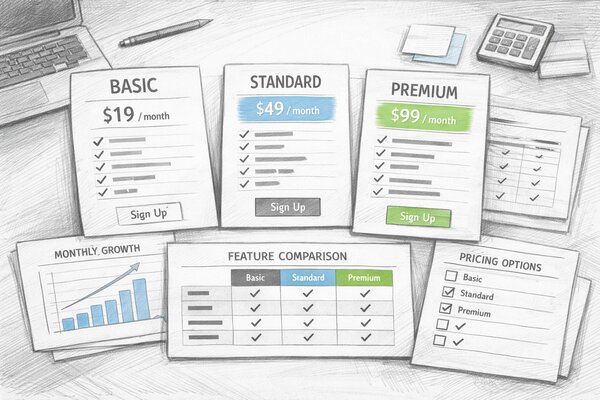
Open the pricing page of any SaaS product. You will see three or four columns. A free tier with crippled functionality. A “Pro” tier that unlocks half the features. An “Enterprise” tier that finally gives you everything — but hides the price behind a “Contact Sales” button.
The worst offender in our industry? The “SSO tax.” Single sign-on is a basic security feature. It costs virtually nothing to implement once. Yet companies charge hundreds of pounds per month for it — precisely because enterprises need it and will pay whatever is asked. That is not pricing. That is a hostage negotiation.
The moment you start hiding features behind tiers, you stop selling a product and start selling access to your own product.
What Feature Gating Actually Does#
Feature gating creates three problems that most SaaS companies quietly accept:
It Punishes Small Teams#
A three-person studio needs the same core features as a 300-person agency. They need version control, commenting, client portals, and decent permissions. They don’t need these features less — they just have less money. Gating features by tier means the smallest teams get the worst tools. That is backwards.
It Creates Invisible Friction#
Every time a user hits a “Upgrade to unlock” wall, something happens: they stop. Some upgrade. Most work around it. A few leave entirely. You will never see the people who left in your analytics, because they never complained. They just quietly found an alternative that did not make them feel nickel-and-dimed.
It Distorts Your Product#
When revenue depends on feature gates, your product team starts optimising for upsell triggers instead of user experience. The roadmap shifts from “what do our users need?” to “what can we lock behind the next tier?” You build features specifically designed to be withheld. That is a toxic incentive.
The DAM Industry Is Especially Bad at This#
As of March 2026, digital asset management is a $4.9 billion market growing at 16% per year(opens in new tab). It should be fiercely competitive. Instead, most DAM pricing pages are deliberately confusing. Here is what you typically encounter:
- Storage sold in tiny increments with overage fees
- Advanced metadata and search locked behind enterprise tiers
- API access treated as a premium feature
- Branding and white-labelling as add-ons
- SSO and audit logs reserved for the most expensive plan
The result? A team evaluating DAM solutions has to sit through demos, request quotes, negotiate contracts, and play the “enterprise sales” game — just to find out if they can afford the product. We think that is absurd.

What We Did Instead#
Let me take you back to September 2025. After a heated discussion where everything started falling apart again, I tried a different approach and decided to calculate what actually creates the bulk of the cost.
It turned out to be two things. Files — they accumulate, and offering unlimited storage while handling heavy processing, indexing, and metadata storage simply is not viable. And users — that same per-seat pricing. Every user on the platform generates requests, uploads, downloads — in short, the very load that shows up on our infrastructure bill.
And even at that point, per-seat pricing still felt uncomfortable: we would be punishing teams for collaborating. The solution came in an elegant form. Since we have to charge for the number of people on the platform, we can bundle 10GB of storage with every seat as a bonus — and include everything inside that bundle: AI tagging, SSO, all of it.
Every feature in this table is included in every YetOnePro plan — including the free one.
| Feature | YetOnePro | Industry Typical |
|---|---|---|
| SSO (SAML 2.0 & OIDC) | Included | Enterprise-only. £2,500+/mo, custom quote. |
| Branded Client Portals | Unlimited | Basic portals free. Custom branding: Enterprise-only. |
| Visual Comments & Annotations | Included | Mid-tier+. Some sell “proofing” as a separate add-on. |
| Video Timestamp Comments | Included | Rare in DAM. Separate tools (Frame.io) cost £12–20/user/mo. |
| Version Comparison | Side-by-side & overlay | Most offer version history only. Visual diff is almost non-existent. |
| Custom Roles & Permissions | Unlimited roles | Basic roles free. Custom roles: Enterprise-only. |
| AI-Powered Search | Included | Higher tiers. Canto, Cloudinary gate AI to premium plans. |
| Audit Trails | Full log, every action | Basic logs free. Exportable audit: Enterprise-only. |
| Two-Factor Authentication | Included | Usually free. Cloudinary: £180+/mo tier. |
| Upload Links | Included | Generally included. Table-stakes. |
| Portal Analytics & View Tracking | Included | Mid-tier+. Advanced analytics: Enterprise-only. |
| Link Expiration & Download Controls | Included | Generally included. Token-based signing: £180+/mo. |
The worst strategy is to compete on price. It fails almost every time. When the decision to use a £5 block — one seat plus 10GB — was finalised, it felt unsettling: we were entering an Enterprise market with an offer that looks like we are dumping. We are not. The price is carefully calculated and gives us plenty of room to operate, maintain proper backups not only for the database but for user files as well.
That is why we do not position ourselves as a “cheap alternative” — because we are not one. We aim to become the solution that is perceived as the standard. Our positioning was and remains: we are a next-generation DAM that includes the most important and premium features while staying accessible to the SMB market. We bring Enterprise-grade quality to a broader audience and build long-term relationships with the companies we serve.
The only thing that scales with your usage is storage and team size — and we made that simple too. Each £5/month block adds 10GB of storage and one team member. Need more? Add another block. That is it. No negotiations, no sales calls, no surprise invoices.
The Revenue We Left on the Table#
Let me be honest: this decision costs us money. We know it does.
If we gated SSO behind an enterprise tier at £50/month, some customers would pay it. If we charged extra for unlimited portals, agencies would grudgingly hand over their credit cards. If we sold storage and seats separately, we would extract more from larger teams.
We did the maths. We could charge 2–3x more per customer with a traditional tiered model. That is real revenue we are consciously not capturing.
So why do it?
Trust Compounds#
When a customer signs up and immediately gets everything — no surprises, no upgrade prompts, no locked features — something happens. They trust you. They tell colleagues. They do not hedge their commitment by keeping a backup option on standby. Trust is not on any SaaS metrics dashboard, but it compounds faster than MRR.
Simplicity Sells#
We built automatic scaling so that everything works seamlessly. Invite a new team member? They are accepted immediately — you will be charged for the remainder of the current billing period alongside your regular invoice, and yes, it automatically adds 10GB of storage.
Deleted large files and have unused blocks? Autoscale will automatically reduce your consumption and remove the unnecessary blocks. You do not need to worry about managing it manually — we handle it as efficiently as possible. But if you prefer to manage things yourself and have a fully predictable billing cycle, that option is also available and easily toggled in your account settings.
We do not need a sales team to explain our pricing. A designer can look at our page, understand it in 30 seconds, and start a trial. No demo required. No procurement process. No three-week evaluation. That speed of adoption is worth more than the extra revenue we could extract.
It Keeps Our Incentives Clean#
Frankly, open and flat pricing allowed us to drop the idea of hiring sales managers altogether. We are not hiding anything behind a large Enterprise tier, and any team can use our free plan — which includes the owner and one bonus team member — to test everything. It is all out in the open. And this reduction in sales costs also lets us earn more while remaining stable and predictable for our customers.
When we build a new feature, we ask one question: “Does this make the product better?” Not “Which tier should this go in?” Not “Can we gate this to drive upgrades?” Every feature we build goes to every customer. That is a liberating constraint. It means our roadmap is driven by user needs, not monetisation strategy.
Isn’t This Naive?#
Maybe. Some investors would certainly think so. The playbook says you should maximise revenue per customer, expand seats, gate features, and drive NRR above 120%.
But we have seen what that playbook produces. It produces pricing pages with 47 checkmarks in a comparison table. It produces “custom pricing” that translates to “we will charge you as much as we think you can afford.” It produces products that actively frustrate their own users to squeeze out another upgrade.
We would rather grow slower with customers who genuinely like using our product than grow faster by taxing people for features they need.

A Bet on Transparency#
The DAM market is worth billions. It is growing fast. There is room for many approaches. Ours is simple: give everyone everything, charge fairly for what actually costs us money (storage and usage), and trust that transparency wins in the long run.
We do not think this is the only way to build a business. But we believe it is the right way to build our business. If you have ever been frustrated by a pricing page that felt designed to confuse you, we built YetOnePro for you.
No tiers. No gates. No tricks. Just tools.