Key Takeaways — brief reading, less than 30 seconds
- Marketing ops optimizes the funnel and the campaign; creative ops optimizes the asset and the deliverable. Different units of work mean different metrics, tools, and talent.
- The org chart should split at the intake-to-delivery handoff: requests (brief, audience, KPIs, specs) go in; finished, approved, tagged assets come out.
- The creative ops workflow has four stages — intake, routing, review and approval, delivery. Marketing touches intake and review but owns nothing inside the pipeline.
- Reporting line is the real decision, not the seam (which never moves). Report to creative for autonomy; report to marketing ops for data and a seat at the planning table.
- Tooling follows the split: marketing ops lives in the martech stack; creative ops lives in a DAM organized around the workflow plus a proofing layer — not a passive file store.
- Three responsibilities are genuinely shared across the seam: capacity-vs-demand forecasting, the intake-to-delivery SLA, and measuring the creative team’s value.
Glossary7 terms
- Marketing operations: The systems, data, and process behind getting campaigns to market — CRM, marketing automation, attribution, and the analytics that optimize the funnel.
- Creative operations: The workflows, resources, and governance behind producing on-brand assets on time, spanning the end-to-end creative workflow from intake to delivery.
- The seam: The intake-to-delivery handoff where a request becomes production work. The point at which the org chart should split between the two ops functions.
- Unit of work: The thing a function optimizes. For marketing ops it is the campaign; for creative ops it is the asset or deliverable. Different units drive different metrics and tools.
- Creative ops workflow: The four-stage spine of the creative ops function: intake, routing and resourcing, review and approval, then delivery.
- Version sprawl: Multiple competing "final" copies of an asset with no agreed winner — the direct cost of an ungoverned handoff and no single source of truth.
- DAM: Digital asset management — software for storing, organizing, and distributing files. A creative-ops DAM is organized around the workflow, not a passive file library.
Editor's note: This is an operator’s take on a structural question, not an HR policy. The reporting-line advice below is built from common patterns across in-house creative teams and agencies as of early 2026; your org will vary. Treat the frameworks as a way to argue the decision well, not as a rule to copy.
The same meeting plays out at company after company, and it always wears a different costume. Someone in marketing operations wants creative work to plug neatly into the campaign calendar. Someone running the creative team wants the calendar to respect what production actually costs in hours and revisions. The argument is framed as a process problem — a missing form, a better brief, another sync — but it’s really an org-chart problem in disguise. Two functions are sharing one workflow and pretending the line between them is obvious.
Most articles on creative operations vs marketing ops answer the easy version of the question: what’s the difference? You can find that table on plenty of blogs, and they all end the same way, with “now go align.” I want to answer the harder one the title promises. Not “how do these two functions differ,” but where exactly the line goes on the org chart, and why it belongs there and not somewhere else. My answer, stated up front: the split should fall at the intake-to-delivery handoff. Everything left of intake is marketing’s problem; everything from intake to delivery is the creative org’s. And that same seam is the spec for the tools each side should buy.

Marketing Ops vs Creative Ops, Defined So You Can Actually Tell Them Apart#
Here are two definitions short enough to repeat in a hallway. Marketing operations is the systems, data, and process behind getting campaigns to market. Creative operations is the workflows, resources, and governance behind producing on-brand assets on time. One owns how demand becomes a campaign; the other owns how a brief becomes a finished, approved deliverable.
If you want a single sentence that separates them, it’s this: marketing ops optimizes the funnel and the campaign; creative ops optimizes the asset and the deliverable. A marketer in MOps asks “did this campaign move pipeline?” A coordinator in creative ops asks “did this asset ship on brand, on time, with the fewest revision rounds?” The questions barely overlap, which is the first clue that you’re looking at two functions, not one.
The authoritative framing of creative ops, from the proofing and creative-management world, is that it connects people, process, and tools across the end-to-end creative workflow(opens in new tab) — intake through delivery, not just “managing designers.” Creativeforce frames it(opens in new tab) as a production system that uses technology to remove pain points and deliver what stakeholders requested on time. That’s the part the org-chart argument keeps missing — creative ops is a system, not a team of people who happen to make things.
Creative ops builds the road. Project management drives a specific car down it.
One clarification before we go further, because the terms get muddled. Creative ops is not creative project management. Ops designs the system — the intake form, the routing rules, the governance, the metric set. Project management runs each project inside that system. Blur the two and you end up with a senior coordinator firefighting individual deadlines and calling it “ops,” while nobody owns the system itself.
The Split, Drawn as a Comparison Table#
Here is the side-by-side. Read the metrics row twice — it’s the load-bearing one. The day two functions are measured on different numbers is the day they need different leaders, different tools, and a clean handoff between them.
| Dimension | Marketing Ops | Creative Ops |
|---|---|---|
| Primary objective | Get campaigns to market and optimize the funnel | Produce on-brand assets on time, from brief to delivery |
| What they own | Demand, data, the campaign calendar, the martech stack | The asset journey: intake, routing, review/approval, delivery |
| Success metrics | Pipeline, MQL/SQL, attribution, CAC, ROI | Throughput, cycle time, on-time %, revision rounds, brand compliance, utilization |
| Core tooling | CRM, marketing automation, CDP, analytics | DAM, online proofing, project management, creative suite |
| Team makeup | Analysts, automation specialists, marketers | Designers, writers, producers, coordinators |
| Unit of work | The campaign | The asset / deliverable |
The tooling row is where this article stops agreeing with the others. Marketing ops lives in the martech stack: CRM, marketing automation, a CDP, an analytics suite. Creative ops lives somewhere else entirely — a DAM, an online proofing layer, a project tool, and the creative suite itself. These are not two flavors of the same software. They’re two stacks, because they serve two units of work. A campaign is the unit on the left; an asset is the unit on the right.
Many introductory guides publish exactly this table and then quit — “there are your key differences, good luck.” The table is the setup, not the answer. The interesting question starts once you accept that these are two functions with two stacks: where does the org chart cut between them?
Where the Org Chart Should Actually Split: The Intake-to-Delivery Seam#
The handoff is precise, so let’s be precise about it. What flows in to creative ops is a request: the brief, the audience, the objectives and KPIs, the channel and format specs, and the deadline. What flows out is a finished, approved, correctly tagged and versioned asset, ready for the channel that ordered it. That request-in, asset-out boundary is the literal point where the org chart should split. To the left of it, the work is demand, strategy, and data. To the right, it’s production, craft, and governance.
The creative ops workflow is the spine of everything on the right, and it has four stages: intake, then routing and resourcing, then review and approval, then delivery. Map those against the handoff and the boundary draws itself. Marketing touches intake — it submits the request and it shows up again at review to approve. But it owns nothing inside the four stages. Creative ops owns the whole pipeline from the moment a request lands to the moment an asset ships. Everything left of intake is MOps territory; everything from intake to delivery is creative ops.
Why here, and not at some other join? Because this is exactly where the work changes shape. Left of intake, you’re reasoning about demand, segments, attribution, spend — a quantitative, data-shaped job. Right of intake, you’re reasoning about capacity, revision rounds, brand compliance, file versions — a throughput-shaped, craft-shaped job. The metrics differ, the tools differ, and so does the talent you hire. When the nature of the work flips, the reporting line should flip with it. Splitting anywhere earlier drags creative into demand planning it can’t own; splitting anywhere later strands marketing with production problems it isn’t equipped for.
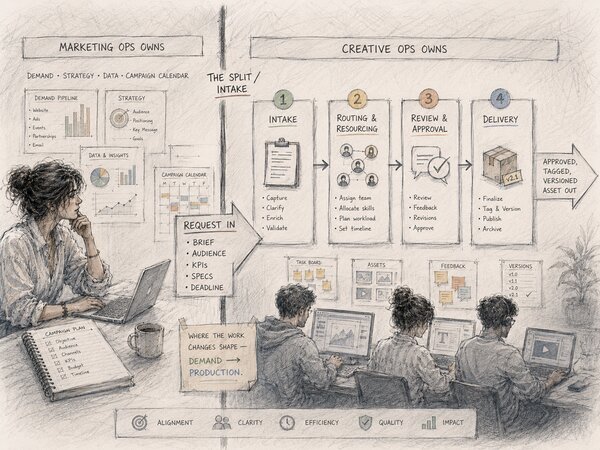
Notice that the seam doesn’t move when the reporting line does. Plenty of writers treat the structure as a coin flip — “alignment matters more than the org chart, it depends.” Alignment does matter. But the handoff is the same regardless of who creative ops reports to: a request goes in, an approved asset comes out, and the four stages happen in between. What changes with the reporting line is only who carries the pipeline — not where it begins or ends. That’s why “it depends” is a non-answer. The boundary barely moves; the decision that actually matters is reporting.
Who Should Creative Ops Report To? A Decision Framework, Not a Shrug#
The trade-off is real, so name it honestly. Have creative operations report up through the creative director or creative leadership, and you preserve autonomy — the work gets defended against last-minute campaign churn, and craft keeps a seat at its own table. Have creative ops report under marketing ops, and you buy proximity to data, budget, tooling, and the strategic planning conversation where the year’s demand for creative assets actually gets set. Each choice protects something and exposes something else.
The cleanest way to decide is to ask which table creative ops needs to sit at most. If your chronic failure mode is creative being excluded from planning — finding out about a launch when the brief lands two weeks before go-live — then proximity to MOps and the planning table is worth more than autonomy, and creative ops should report toward marketing. If your chronic failure mode is campaign deadlines steamrolling production reality — quality and capacity sacrificed every quarter to hit a date — then autonomy under creative leadership is worth more, and it should report there. Diagnose the failure you actually have, then point the reporting line at the table that fixes it.
Company stage settles most of the rest — find yours, and the structure stops being a debate:
- Early-stage. One shared ops function, one or two people wearing both hats. Don’t over-engineer it — a single intake queue and a calendar will do.
- Mid-size. Two connected teams with a named owner on each side of the line and a documented handoff between them. This is where a real creative operations manager earns the title.
- Enterprise. Two distinct orgs with their own headcount, their own budgets, and an SLA across the handoff — intake turnaround, review-round limits, delivery commitments — so the boundary is governed, not negotiated weekly.
How the Split Goes Wrong#
The most common mistake is the hybrid super-role: one “marketing and creative operations” leader meant to own both sides of the handoff. It sounds efficient and it dilutes both. Demand optimization and production governance pull in opposite directions for attention, and whichever one the leader came up through wins by default. The other becomes a side hustle. Two functions measured on different numbers need two owners; folding them into one person doesn’t resolve the tension, it just hides it inside a single calendar.
The second failure is creative excluded from planning. When the creative org only meets a campaign at brief time, every project starts late by construction. Capacity was committed elsewhere, the deadline is already fixed, and creative ops spends the quarter doing damage control instead of resourcing. This is the failure that argues for reporting toward MOps — not because marketing should run creative, but because creative ops needs to be in the room when the year’s demand is forecast.
The third is handoff chaos: no single source of truth for assets. Briefs live in email, feedback lives in five threads, the “final” file has four versions with no agreed winner, and the channel team grabs whichever one was nearest. This is version sprawl, and it’s the direct cost of an ungoverned handoff. We’ve written about how the approval process contains the review rounds; the point here is structural. If nobody owns the pipeline from intake to delivery, the assets scatter, and no amount of marketing-side discipline fixes it — because the problem is on the right of the seam, not the left.
Why the Tooling Follows the Split#
Once you accept that the seam is real, the tooling stops being a preference and becomes a consequence. The martech stack — CRM, marketing automation, CDP, analytics dashboards — is built to optimize the funnel. It tracks campaigns, scores leads, attributes pipeline. None of it is built to route a brief, run a review round, or hold the canonical version of a file. That’s not a gap in the martech stack; it’s just the wrong side of the seam.
The creative ops side needs its own backbone, and the center of it is a DAM organized around the four-stage workflow — not a passive file library. A folder of finished files is where assets go to be forgotten; it has no concept of intake, no routing, no review state, no notion of which version is approved. A creative-ops DAM, by contrast, mirrors the pipeline itself: a request comes in, it gets routed, it moves through review and approval, and it lands as a tagged, versioned, delivery-ready asset with one unambiguous winner. The workflow is the spec for the tool. That’s precisely why we built YetOnePro around the intake-to-delivery journey instead of bolting a file store onto someone else’s martech stack — because a tool that ignores that journey is just storage with a search box.
This is also where the version-sprawl failure gets solved structurally rather than through nagging. When the DAM holds the canonical asset and tracks its versions and approval state, “which file is final?” stops being a question — the system answers it. If your team is still living in shared drives, the move to a workflow-shaped DAM is the single highest-leverage step on the creative ops side; we walk through it in the guide on moving off Google Drive, and the version problem specifically in version control for designers.
Who Owns What: A Practical Breakdown#
Theory is cheap; the boundary earns its keep when you can assign concrete responsibilities to one side or the other. Here’s a working RACI-style split across the responsibilities that usually start the turf war. Use it as a starting draft and argue the edge cases against the seam, not against personalities.
- Lead scoring and funnel optimization — Marketing Ops. Pure demand work, well left of intake.
- Campaign calendar and channel planning — Marketing Ops. Decides what gets requested and when.
- Attribution, ROI reporting, and the analytics dashboard — Marketing Ops. The funnel’s scoreboard.
- Marketing automation and the martech stack — Marketing Ops. Their tooling, their uptime.
- Intake form and request triage — Creative Ops. The first stage of the pipeline; design it as a real form, the way we lay out a creative brief template.
- Routing, resourcing, and capacity management — Creative Ops. Who picks up the work, and whether there’s room for it.
- Review and approval workflow — Creative Ops. The rounds, the proofing, the sign-off.
- Brand asset governance and the DAM — Creative Ops. Tagging, taxonomy, versioning, and the single source of truth — see our metadata taxonomy guide.
- On-time delivery and throughput metrics — Creative Ops. Cycle time, revision rounds, on-brand rate.
- Capacity vs demand forecasting — Shared. MOps owns the demand number; creative ops owns the capacity number; the forecast only works when both sit at the same table.
- The intake-to-delivery SLA — Shared. The handoff is the one artifact both sides sign, because it’s the contract across the seam.
- Measuring the creative team’s value — Shared. MOps frames it against pipeline; creative ops frames it against throughput and brand quality; leadership needs both halves to see the whole.
Read that list and the pattern is hard to miss. Almost everything resolves cleanly to one side — and the handful that doesn’t are exactly the items that straddle the seam: forecasting, the SLA, and how you score the creative team’s value. Those three are where the two ops functions are genuinely cross-functional, and they’re the only places the org chart needs a real bridge. Everything else just needs a clean line.
So draw the line at intake-to-delivery. Give marketing ops the demand, the data, and the funnel. Give creative ops the asset’s journey from brief to delivery, and the workflow-shaped DAM that makes that journey governable. Then put a forecast, an SLA, and a shared scorecard across the seam — and stop trying to settle the argument in a weekly sync. The structure settles it for you.
Frequently Asked Questions #
What is the difference between creative operations and marketing operations?
Where should the line between the two functions fall on the org chart?
Who should creative ops report to?
What are the four stages of a creative ops workflow?
How does the tooling differ between marketing ops and creative ops?
Can one person run both marketing ops and creative ops?