Key Takeaways — brief reading, less than 30 seconds
- The pricing model is upstream of the brief. Per-shoot, per-asset, and retainer models produce three different files for the same project.
- Six cost categories every model has to cover: studio space, equipment depreciation, software, talent, insurance, overhead allocation. Plus profit margin.
- Per-shoot day rates ($1k–$8k commercial depending on market and studio maturity, $10k–$25k high-end campaign) work for predictable-scope work; the risk is scope creep within the day.
- Per-shot pricing ($15 bulk to $300 lifestyle per finished image) works for high-volume catalog work; the risk is race-to-the-bottom on quality.
- Retainers ($5k–$50k/month, 10–25% discount on per-shoot rate) work when an outside studio runs like in-house for one anchor brand; the risk is the shoot-day count drifting in either direction.
- The hybrid (day rate base + per-asset overage) is what most established studios converge on. Predictable revenue, fair to both sides, easy to renegotiate.
Glossary8 terms
- Day rate: A flat fee for a contracted shoot day, typically 8–10 hours on site, with a deliverable cap written into the contract. The standard pricing unit for commercial and editorial work.
- Per-image rate: A fee charged per finished, retouched image rather than per day. Common in e-commerce and catalog work where shot count is the primary scope variable.
- Usage rights: The license the brand buys to use the images — web only, print, paid media, territory, duration. Priced separately from the shoot fee on commercial work because broad usage is materially more valuable than the photography labor itself.
- Retainer: A recurring monthly or quarterly fee that includes a set number of shoot days or finished assets. Trades a 10–25% discount on per-shoot rates for revenue predictability and booking priority.
- Kill fee: A partial fee paid to the studio when a client cancels a booked shoot inside a contractual window (usually 48–72 hours). Compensates for the lost calendar slot the studio can no longer rebook.
- Model release: A signed legal document granting the studio and its client permission to use a person’s likeness in commercial photography. Required before any image of a recognizable person can be used in marketing.
- Packshot: A clean product image on a plain (usually white or neutral) background, optimized for e-commerce listings. The high-volume, repeatable end of per-shot pricing.
- Lifestyle shot: A composed image showing a product in context — on a styled set, with models, or in an environmental scene. Higher per-shot rate than a packshot because of the setup, styling, and creative direction required.
Editor's note: This is operational and business content, not a software guide. Useful for studio owners building a pricing model and for clients who hire studios and want to understand the invoice.
A brand books “a shoot day.” The studio shoots the day, then sends an invoice with three line items the client never put in the budget: 14 finished images over the cap, a usage license for paid social, and two hours of overage. Nobody lied. Both sides did exactly what they thought they had agreed to — they were just working from different pricing models, and no one said which one out loud.
Three models cause most of those gaps. Like a restaurant, a studio can charge you a prix-fixe (one price for the day), à la carte (per finished image), or run a standing tab (a fixed monthly retainer) — same craft on the plate, a different bill depending on the menu.
And the model is upstream of everything else. The workflow article covers what the studio actually delivers; this one covers what the invoice looks like — and what the brief had to say for the invoice to land without a fight. Both sides of the deal are better off understanding the model the other is working from.

Why the Pricing Model Determines the Brief#
What a studio optimizes for changes with the model — per-shoot studios run the calendar around the day, per-asset studios run it around shot count, retainer studios run it around predictability for one or two anchor clients. The choice shapes everything downstream: where the photographer’s attention sits, what queue the retoucher works from, what the client opens at the end. The brief that opens the work changes shape too: the per-shoot brief leads with mood and a shot list capped at the day’s output; the per-asset brief is the catalog or shot manifest; the retainer brief is annual planning, not a single project.
Photo businesses divide naturally into four scopes. Commercial studios shoot for brands, agencies, and product launches; their pricing tends toward per-shoot day rates with usage rights as a separate negotiation. Portrait and headshot studios serve individuals and small businesses; pricing tends toward sessions priced as packages with prints or digital files included. Event and wedding photography prices the day plus deliverable count, often with album options. E-commerce product studios shoot at high volume against repeatable lighting setups; pricing tends toward per-shot rates with white-background simplicity at the bottom of the range and lifestyle composition at the top. The model that fits each scope differs because the cost structure does.
The Cost Basis — What Every Model Has to Cover#
Pricing-model choice is downstream of cost structure. Before you pick a model, you need to know what each shoot has to recover. Studios that price without understanding the cost basis end up working below margin without knowing it; clients that hire without understanding it end up surprised by what looks like padding on the invoice. Six categories cover it — the ranges below are operator estimates from US-mid-market studios we’ve worked with, not published benchmarks. Region, headcount, and equipment mix shift the numbers, so use them as a starting frame rather than a quote.
- Studio space. Rent, utilities, insurance for the building, parking. The fixed monthly cost the studio owes whether it shoots or not. A 1,500 sq ft commercial studio in a mid-sized US market runs $4–8k/month in rent plus $1k in utilities.
- Equipment depreciation. Cameras, lenses, lighting, stands, computers. Typically 3–5 year amortization. A working commercial kit ($60k of bodies, lenses, lighting, and computers) depreciates at $12–20k/year, which translates to $150–300 per shoot at 60–80 shoots/year.
- Software. Lightroom, Capture One, Photo Mechanic, retouching tools, DAM platform, client gallery delivery. Add up annual subscriptions ($2–5k for a working studio) and divide by shoot count.
- Talent. Photographer’s day-rate equivalent, retoucher labor, assistants, occasional stylists or producers. The most flexible cost; the one that creates most of the disagreement at scaling. Junior retouchers $25–40/hr; senior retouchers $60–120/hr; assistants $200–400/day.
- Insurance. Liability for the studio space, equipment insurance, errors-and-omissions coverage for commercial work. Annual cost prorated per shoot; usually $50–150/shoot for a working commercial studio.
- Overhead allocation. The share of shared cost each shoot has to cover — the bookkeeping, the marketing time, the website, the time spent quoting work that didn’t book. The number nobody has on hand and that makes pricing-model discussions go sideways. Mature studios estimate this at 15–25% of variable cost.
Plus profit margin. If a model doesn’t leave room for it, the studio is paying to work. In our experience, sustainable studios target 20–35% net margin after all of the above; below 15% is the early sign the pricing model isn’t holding — again, operator rules of thumb, not industry-published numbers. The PPA Financial Benchmark survey(opens in new tab) publishes broader industry data on cost-of-sales and profitability ranges across photography businesses, useful as a cross-check on your own numbers.
A two-photographer commercial studio with $18k/month in fixed costs (rent, software, equipment depreciation, insurance) shoots 8 days/month. Before talent and profit, every shoot day must clear $2,250. Add talent ($1k/day for the photographer, $400/day for an assistant, $300 for retouching at $50/hr × 6 hours): another $1,700/day. Add a 25% markup on cost: another $990. The break-even-with-margin day rate works out to roughly $5,000. Pricing below that loses money on the average shoot day, which the studio won’t feel until the quarterly P&L lands. Substitute your real fixed costs and talent rates and the answer shifts; the shape of the calculation doesn’t.
Once you know what a shoot has to recover, the three pure models and the hybrid line up like this — the at-a-glance version before the sections that follow go deep on each.
| Model | Best fit | Typical range | Main risk | Contract guardrail |
|---|---|---|---|---|
| Per shoot | Campaign work, scope known up front | $1k–$8k/day; $10k–$25k high-end | Scope creep within the day | Deliverable cap + per-image overage rate |
| Per asset | High-volume, repeatable setups | $15–$300 per finished image | Race to the bottom on quality | A floor price you decline to go below |
| Retainer | One anchor brand, steady demand | $5k–$50k/month, 10–25% off | Over- or under-use; the count drifts | Quarterly use review + renegotiation clause |
| Hybrid | Most established commercial studios | Day rate + per-image overage | Inherits all three, mildly | Cap + overage + quarterly review |
How to read the ranges. Every dollar figure here is an operator estimate — drawn from the US studios we’ve worked with and sanity-checked against published aggregator data, not a rate card you can hold a studio to. Use them to sense-check a quote, not to set one; the sources cited along the way (PPA, SideStackers, The Knot, Wonderful Machine) are directional cross-checks, not where the bands come from.
Per Shoot (Day Rate)#
Write one line into the contract and day-rate pricing holds: “Up to 50 finished images for the day; additional finished images at $80 each.” That cap is the whole mechanism. The studio sells a known day — one price, a contracted deliverable count, eight hours on site — and the client briefs against a number they can put in a budget. It is the model campaign work lives in, for exactly that reason.
The day itself runs $1,000–$5,000 for general commercial work in most US markets; established commercial work in major metros runs $2,000–$8,000 depending on studio maturity and usage scope, and high-end campaign work runs $10,000–$25,000/day plus usage rights (SideStackers(opens in new tab)’ aggregator survey lands in the same neighborhood). Portrait work prices as packages rather than days — $400–$2,500 for studio time, a curated edit of 15–30 images, and prints or files. Event and wedding photography runs $2,000–$10,000 for an eight-hour day, around $3,000 on average per the Knot Real Weddings Study(opens in new tab).
Drop the cap and the day quietly overruns. “While you’re here, can you also shoot…” adds to the deliverable count without adding to the fee, and the contract turns back into an estimate. The cap is what makes the day rate a price instead of a hope — which is why the model only suits work whose scope is settled before the shoot starts.
Per Asset (Per Shot)#
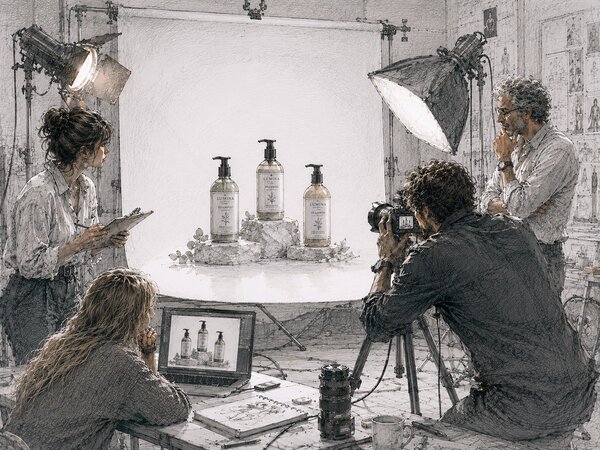
The same lip balm, two ways: $35 on a white sweep, $220 styled on a marble slab with props and a hand model. Per-shot pricing bills by the finished image, and that swing is the whole story. It ties the studio’s pay to output and lets the client buy only what they use — and it quietly rewards volume in a way that can erode the craft it is paying for.
E-commerce product photography is where per-shot pricing dominates: $15–$300 per finished image by complexity and volume. White-background work on a turntable rig runs $25–$50 at standard volume, dropping toward $15 in 100+-shot tiers — the studio optimizing for throughput. Styled lifestyle work with sets, stylists, and longer setups runs $75–$300, higher for model-led campaigns — the studio optimizing for craft. The same product produces a 3–8× range depending on which, so the brief has to say which.
Left unchecked, the model races to the bottom. Clients picking purely on shot count push the price under the cost basis; studios chasing the volume cut corners on retouching, lighting, and styling; the work degrades; the client churns and rehires more expensively somewhere else. High-volume per-shot photography works the same way for real estate listings as for catalog product. What saves it is repeatability: the per-image math only clears the cost basis where the setup genuinely repeats, and it bleeds money the day the images stop being the same.
Retainer (Monthly / Quarterly)#
The retainer that doesn’t renew usually died of arithmetic nobody did. The brand committed to $20k a month, used four shoot days one quarter and one the next, and at renewal one side feels robbed. A retainer is a fixed fee per month or quarter for a set number of shoot days or assets: the studio trades a discount for cash it can count on, the brand trades commitment for booking priority and a lower effective rate. It holds only if both sides watch the count.
Retainers for an outside team that works like in-house run $5,000–$50,000/month by scope, at a 10–25% discount on the equivalent per-shoot rate (Wonderful Machine’s pricing-and-negotiating-retainers piece(opens in new tab) covers the mechanics). One shoot day a week with 30 finished images might run $20k/month against a $5,500/day rate — a notch above the worked example’s $5,000 for a more established studio — saving the brand about 16% on the equivalent per-shoot total and handing the studio a $240k annual account it can plan around without chasing it.

The danger runs both ways and ends in the same place. Pay for shoot days you don’t use and the retainer feels like waste; use more days than it covers and it feels like the studio is being worked at a discount — either way it doesn’t renew. The fix is keeping score out loud: a quarterly review of days used versus contracted, with a clause to renegotiate if the count drifts more than 20% in either direction. The model earns its keep only where the brand’s demand is steady enough that the studio can bank on the calendar.
The Same Job, Three Invoices#
Take one real shape of job. A skincare brand books a studio for 42 packshots — clean white-background images of the full range for a new e-commerce site. Halfway through the day the marketing lead loves the look and asks for 12 lifestyle variants too: three hero products styled on marble with props, for the homepage and paid social. Same studio, same afternoon. Three pricing models, three different invoices.
Per shoot. The day rate was $4,500 for a packshot day, up to 50 finished images. The 42 packshots fit. The 12 lifestyle shots don’t — different setup, different lighting, a heavier retouch — so they either eat the remaining cap while the studio absorbs the styling cost, or they trigger a scope conversation mid-shoot that nobody enjoys. The invoice stays clean only if the cap language anticipated a second setup.
Per asset. 42 packshots at $30 is $1,260; 12 lifestyle variants at $180 is $2,160; total $3,420. The mid-shoot addition is a non-event — the client already pays per image, so twelve more is twelve more lines at the lifestyle rate. This is per-shot pricing’s best day: a scope change that needs no renegotiation.
Retainer. If the brand is on a $20k/month retainer, the whole job — packshots, lifestyle, and the change of heart — comes out of the period’s allotment. Nothing is itemized on the day. The accounting waits for the quarterly review, where the only question is whether the brand is using the days it is paying for. The mid-shoot ask never registers as an event.
Same 54 images. The per-shoot invoice argues about the cap, the per-asset invoice just adds lines, the retainer invoice doesn’t move at all. That is the entire case for matching the model to how the work actually arrives — and it is why most studios stop choosing and run the hybrid.
The Hybrid Most Successful Studios Run#
Day rate base plus per-asset overage. The model most established commercial studios converge on after the first year or two, because it combines the predictability of per-shoot with the alignment of per-asset.
A $4,000 day rate includes 30 finished images; each additional finished image is $80. The brief negotiates the deliverable count up front; overages are anticipated, not surprises. The brand budgets confidently; the studio gets predictable revenue plus upside on the campaigns where the client wants more output. When the deliverable count goes from 30 to 50 because the campaign expanded mid-shoot, neither side is surprised by the invoice.
The cost-basis section earlier told the studio what the day rate must be (around $5,000 in the worked example). Each pure model has its own way of failing: per-shoot overruns, per-shot races to the bottom, the retainer’s day count drifts. The hybrid blunts all three — the day rate covers the fixed daily cost basis with margin, the overage rewards the extra volume instead of fighting it, and the quarterly review keeps the relationship from sliding either way.
We wrote about our own pricing philosophy from the SaaS side; the underlying principle is the same. A model the customer can predict beats clever discounts. The studios that retain clients aren’t the ones who came in cheapest — they’re the ones whose math the client can run on their own before the invoice arrives. Surprises kill retention even when they go the customer’s way. And the math only stays runnable when the things the model prices — the brief, the deliverable cap, the approved usage rights, the final assets — live somewhere both sides can see. Scattered across email, a hard drive, and someone’s memory of what got agreed on the day, the same numbers quietly stop adding up.
Frequently Asked Questions #
Which pricing model earns the studio the most?
Should I charge for usage rights separately from the shoot fee?
When does a retainer make sense for the studio?
What’s a fair day rate for a commercial photo studio?
How do I move a client from per-shoot to a retainer without losing them?
Do I need a kill fee clause and what should it cover?